SolarEdge and Enphase together account for a substantial share of the residential and commercial solar inverter market in the United States. If you are building energy management software, a demand response platform, or any application that needs to read from or control solar installations, you are going to integrate both. And the moment you do, you will discover that they have almost nothing in common at the API level.
This is not a complaint about either company. Their APIs are well-documented and reasonably reliable. The problem is that two good-but-different APIs are still two different integrations to build, maintain, and debug. When you add a third vendor — SMA, Fronius, ABB — the pattern compounds. We have seen engineering teams spend 40 percent of their development capacity on integration maintenance for a product that should spend 80 percent of its engineering cycles on user-facing features.
Where SolarEdge and Enphase diverge
The differences between the two APIs go beyond naming conventions. The architectural approaches are fundamentally different, which shapes the complexity of building against each.
SolarEdge uses a cloud-to-cloud REST API where the developer queries SolarEdge's monitoring platform for aggregated data about a site. Authentication is API-key based. Data is site-centric: you get readings for a site's total production, component-level energy, and equipment status. The API is well-suited for portfolio monitoring but does not expose real-time inverter control.
Enphase uses the Enlighten API, which is OAuth 2.0 authenticated and returns data at the microinverter level — each panel's output rather than aggregate site production. This granularity is valuable for diagnostics but creates more data volume to process. Enphase also separates production data (energy output) from consumption data (home energy use) into different API endpoints.
| Dimension | SolarEdge | Enphase |
|---|---|---|
| Auth | API key | OAuth 2.0 |
| Data granularity | Site and component level | Microinverter level |
| Time resolution | 15-min, hourly, daily | 5-min intervals for recent data |
| Power field name | currentPower (W) | powr (W) |
| Energy field name | energy (Wh) | enwh (Wh) |
| Timezone handling | Site-local timezone in params | Unix timestamps in response |
| Rate limits | 300 requests/day per API key | 10 requests/minute per token |
Even the field names for the same physical measurement differ. SolarEdge returns currentPower in watts; Enphase returns powr in watts. Both are watts. Neither is wrong. But your normalization layer has to know this distinction for every field it maps.
What this costs in practice
The initial integration cost is the obvious part. Building a SolarEdge integration from scratch — OAuth or API key setup, endpoint mapping, error handling, test coverage — takes a competent engineer three to four weeks. Enphase adds another two to three weeks. Call it six weeks for two vendors.
The ongoing cost is less visible but larger over a product's lifetime. We have measured integration maintenance at roughly one engineering week per vendor per quarter for a mature DER software product. Three solar vendors means three weeks per quarter, or 12 weeks per year, of engineering capacity that never ships product features.
The hidden third cost is data pipeline complexity. When your application receives solar production data, it needs to know which vendor format to expect and apply the right parsing logic. If that logic is scattered across the application rather than centralized in a normalization layer, every feature that touches solar data carries a conditional branch for each vendor. That complexity compounds every time you add a vendor.
How normalization eliminates the divergence
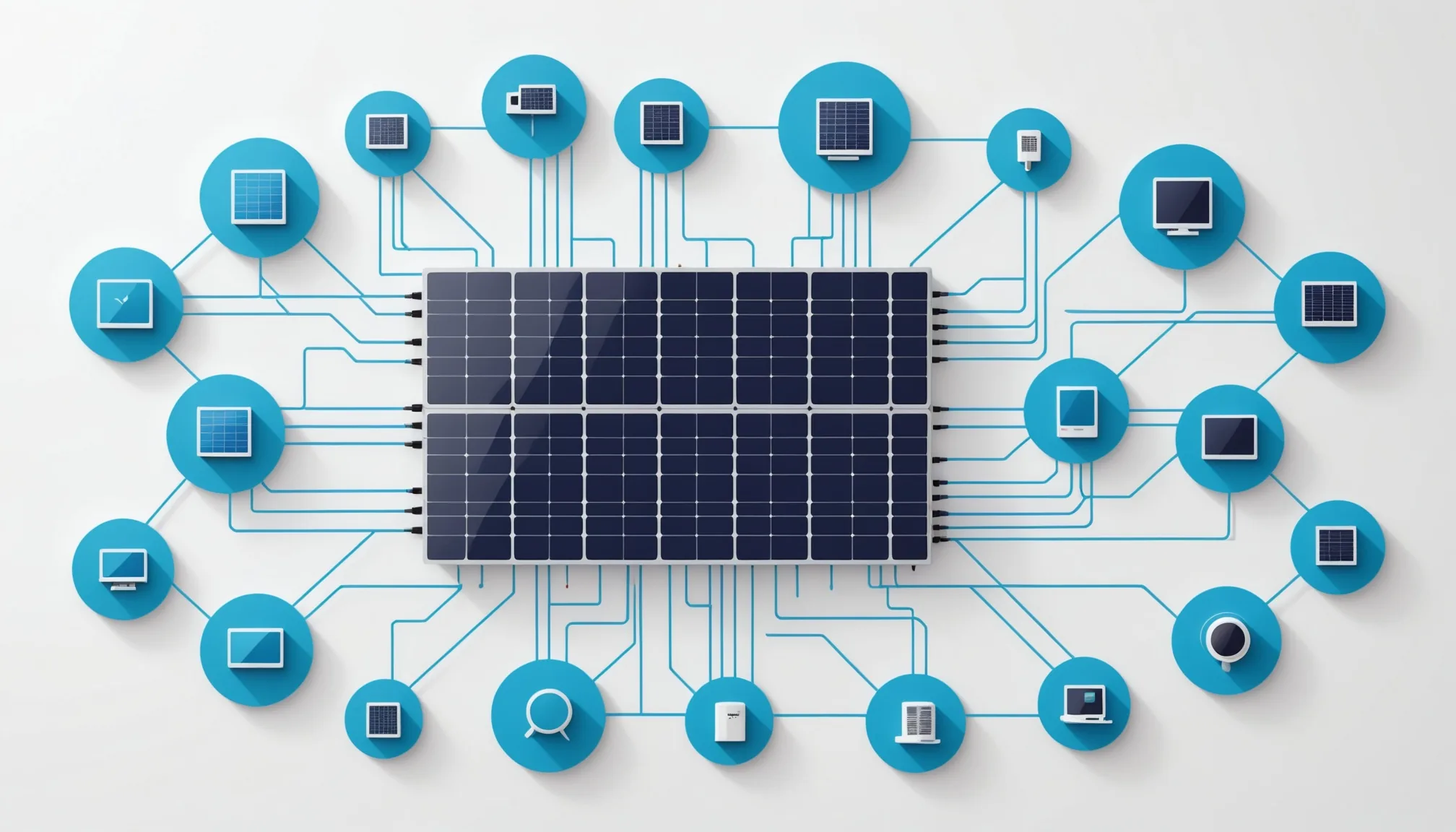
A normalization approach defines a canonical solar inverter data model and maps each vendor's response to it. The canonical model for a solar inverter might look like this:
output_kw— Current AC output power in kilowattslifetime_kwh— Total energy produced since installationtoday_kwh— Energy produced todaygrid_connection_status— Enum:connected,disconnected,faulttimestamp— ISO 8601 UTC timestamp of the reading
Once defined, the normalization layer is responsible for converting every vendor's response into this schema. SolarEdge's currentPower in watts becomes output_kw in kilowatts via a divide-by-1000. Enphase's powr field gets the same treatment. The timezone handling — SolarEdge's site-local timestamps versus Enphase's Unix timestamps — is resolved in the normalization layer, not in the application.
Application code downstream of the normalization layer sees one data shape, always. Adding a third solar vendor means adding an adapter that maps to the canonical schema — not touching application code at all.
Rate limit management
One place where the two APIs diverge in a way that affects product architecture is rate limits. SolarEdge's 300 requests per day per API key is constraining for applications that want to refresh data frequently. If you are building a real-time monitoring product that wants 5-minute refresh intervals for 20 sites, you need 20 requests per refresh cycle, 288 refresh cycles per day = 5,760 requests per day per site. That is well beyond the SolarEdge per-key limit.
Managing this requires a caching layer, intelligent request scheduling, and potentially multiple API keys (with user permission). A normalization layer is also the right place to implement rate-limit-aware request scheduling — it can throttle outbound requests, batch them where the vendor supports it, and serve cached data when the rate limit is approached.
In our experience, rate limit management is the integration problem that tends to surface six months after launch, not during development. Build the abstraction layer for it before you need it.
When authentication models differ
SolarEdge's API key model and Enphase's OAuth 2.0 model present different UX challenges when your application needs to connect on behalf of end users. OAuth 2.0 means users grant your application permission via an authorization flow — they see an Enphase consent screen, approve access, and your application receives a token. SolarEdge's API key model means users need to find their API key in the SolarEdge monitoring portal and paste it into your application.
Neither is inherently better from the user's perspective, but they require different connection flows in your application. A normalization layer that abstracts the auth model — handling the OAuth flow for Enphase and the API key setup for SolarEdge — lets your application present a consistent "connect your solar system" experience regardless of which hardware the user has.
Two vendors. Six weeks to build. Twelve weeks per year to maintain. Every vendor you add compounds the cost. That is the actual arithmetic of un-normalized DER integration, and it is why the abstraction layer is worth building early.